
Microscopic Root Canal Treatment: Greater Precision and a Better Chance to Save Your Tooth
What is microscopic root canal treatment and why does it raise success rates? Learn its benefits and which cases need it, and book at Aman Dental Centers in Mansoura.
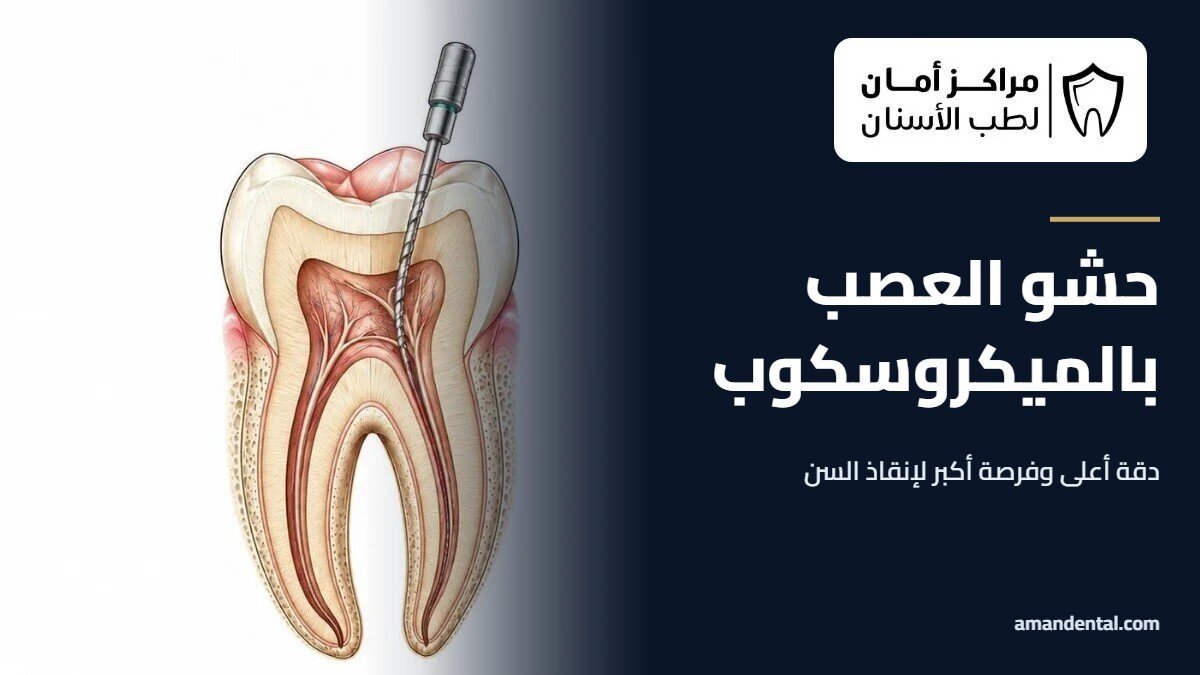
The canals inside a tooth are extremely fine; some are thinner than a hair, and some are curved, branched or hidden. That is why a conventional root canal sometimes fails: a single canal was not found or not cleaned properly. This is where microscopic root canal treatment comes in, magnifying the view inside the tooth many times over. At Aman Dental Center in Mansoura, we rely on magnification and powerful lighting for delicate endodontic cases. In this article, we explain what microscopic root canal treatment is, why it improves the chances of saving a tooth, and when you need it.
What Is Microscopic Root Canal Treatment?
It is root canal treatment performed with a dental operating microscope, which magnifies the field of view about 3 to 25 times with focused light inside the tooth. The treatment steps are not very different from a conventional root canal, but the big difference is precision: the dentist sees canal openings, cracks and debris clearly instead of relying on touch and experience alone. Learn the basics of root canal treatment and tooth nerve pain.
Benefits of Microscopic Root Canal Treatment
1. Finding Hidden Canals
Some molars, especially the upper first molar, have an extra canal that is hard to see with the naked eye. Leaving it untreated is one of the most common reasons root canals fail. Microscopic root canal treatment greatly increases the chance of finding it.
2. More Thorough Cleaning
Magnified vision helps remove inflamed tissue and bacteria from the canals more completely.
3. Preserving Tooth Structure
Because the dentist can see clearly, less healthy tooth tissue needs to be removed to reach the canals, so the tooth stays stronger.
4. Early Detection of Cracks
Tiny cracks in the tooth or root can explain unexplained pain, and the microscope reveals them, helping the dentist make the right decision.
5. Managing Complex Cases
Such as removing a broken instrument from a canal, opening a calcified canal, or repairing a root perforation.
When Do You Need Microscopic Root Canal Treatment?
- Retreating a failed root canal: with returning pain or an abscess. Read about tooth abscess.
- Molars with complex canals: curved or calcified.
- A broken instrument inside the canal from previous treatment.
- A suspected crack: in the tooth or root.
- Front teeth where as much tissue as possible must be preserved to keep their appearance. Read about front tooth root canal.
- When saving the tooth is very important: such as a bridge support or a tooth in the smile zone.
Microscopic Root Canal Treatment Steps
- X-rays and diagnosis: standard X-rays and sometimes a CBCT scan to map the canals.
- Local anesthesia: and isolating the tooth with a rubber dam to keep out saliva and bacteria.
- Opening the tooth and locating the canal openings: under magnification.
- Cleaning and shaping the canals: with modern rotary instruments and disinfecting solutions.
- Filling and sealing the canals: tightly.
- Final restoration: with a filling or crown to protect the tooth. Learn about crowns and bridges.
Microscopic root canal treatment may be done in one or two visits, depending on the case and whether there is infection.
Is Microscopic Root Canal Treatment Painful?
No. It is done under local anesthesia, and it feels similar to a conventional root canal. The appointment may be slightly longer because of the extra precision, but many patients have less pain afterwards because the cleaning was more thorough. Read more in does a root canal hurt?
Microscopic Root Canal or Extraction and Implant?
Keeping your natural tooth is always the first choice whenever possible, as it is usually less costly and more natural. Microscopic root canal treatment saves many teeth that would once have been extracted. But if there is a vertical root fracture or the tooth cannot be restored, extraction and an implant become the better option. Learn about dental implants.
Microscopic Root Canal Cost
The cost of microscopic root canal treatment is higher than a conventional root canal because of the equipment, time and expertise involved. It varies with the type of tooth (front tooth or molar) and whether it is a first treatment or a retreatment. See root canal cost for approximate prices.
Aftercare Tips Following a Microscopic Root Canal
- Avoid heavy chewing on the tooth until the crown is fitted.
- Take the painkiller your dentist recommends if needed in the first few days.
- Do not delay the crown, because a root canal-treated molar is more likely to break.
- Keep your mouth clean and attend regular X-ray follow-ups.
Also read what to eat after a filling.
Root Canal Treatment at Aman Dental Centers
At Aman Dental Centers, we focus on saving natural teeth first, and we use magnification and modern instruments for delicate cases and retreatments. Learn about our root canal service.
Microscopic vs. Conventional Root Canal
| Comparison | Microscopic | Conventional |
|---|---|---|
| Vision | Magnified up to 25x with focused light | Naked eye or simple magnifying loupes |
| Finding extra canals | Clearly higher | Lower in complex cases |
| Tooth tissue removed | Less | Sometimes more |
| Retreatment and removing broken instruments | Possible with precision | Difficult or impossible |
| Appointment length | Slightly longer | Shorter |
The comparison shows that microscopic root canal treatment is not a luxury in difficult cases, but a diagnostic and treatment tool that increases the chances of saving the tooth.
Teeth That Benefit Most from Microscopic Root Canal Treatment
- Upper first molar: because of a possible hidden fourth canal.
- Lower molars: with curved roots.
- Older teeth: with narrow, calcified canals.
- Teeth supporting bridges: that are hard to replace.
CBCT Scans with the Microscope
In complex cases, the dentist combines a 3D CBCT scan to see the canal anatomy before starting with microscopic root canal treatment to carry out the procedure precisely. This reduces surprises during treatment and shows from the outset whether the tooth can be saved or extraction is better. If you have sensitivity after treatment, read about toothache to tell what is normal from what is not.
Ultimately, the goal of microscopic root canal treatment is for patients to keep their natural teeth as long as possible with the highest precision.
Microscopic Root Canal Treatment in Egypt
Microscopic root canal treatment is now available at a number of specialist centers in Egypt, but it is still not offered at every clinic because of the cost of the equipment and the training required. If your case is complex or a previous root canal has failed, look for a center that offers proper magnification and lighting.
Root Canal Retreatment Under the Microscope
Retreatment is one of the most important uses of microscopic root canal treatment. The dentist removes the old filling, looks for a missed canal or leakage, then cleans and refills the canals. In many cases, this saves a tooth that would otherwise have been extracted.
Molar Root Canal Under the Microscope
Molars benefit most from microscopic root canal treatment because they have 3 or 4 canals, sometimes more, and some are very fine. Read about molar root canal treatment.
Single-Visit Root Canal
In cases without severe inflammation, microscopic root canal treatment can be completed in one visit. With an abscess or severe inflammation, the dentist may place medication inside the canals and finish at a second visit.
How to Prepare for a Root Canal Appointment
- Have a light meal beforehand, as the appointment may be long.
- Tell your dentist about any medications or chronic conditions.
- Ask about the restoration plan after the root canal (filling or crown) and its cost.
- Set aside enough time so you are not rushed.
Is the Extra Cost Worth It?
When you compare the cost of microscopic root canal treatment with extraction followed by an implant, saving the natural tooth is usually more economical and more natural. That is why many patients see microscopic root canal treatment as a worthwhile investment, especially for important teeth and complex cases.
Conclusion
Microscopic root canal treatment gives your dentist a clearer view and greater control, raising the chances of saving the tooth, especially in complex cases and retreatments. Before deciding to extract a tooth that could be saved, get a specialist opinion. Book your check-up at Aman Dental Centers in Mansoura, and the Aman team will assess your case and determine whether microscopic root canal treatment is the right option for you.
This information is for general health education and does not replace an in-person dental examination.